Giant Alexander the Great tomb shares clues about ‘young emperor’s death’ in new discovery
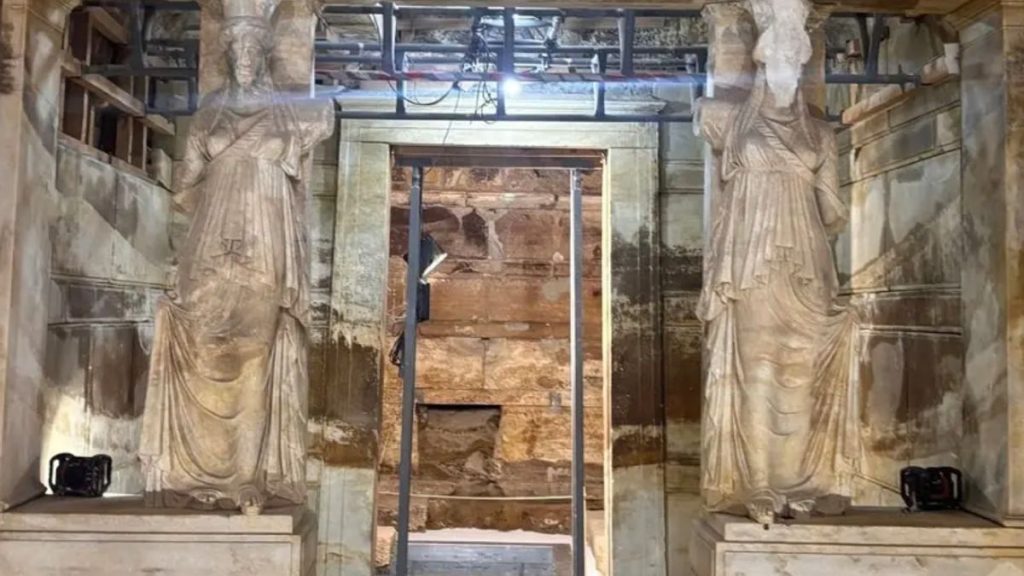
Greek officials revealed restoration work around the Kasta Tomb in northern Greece has uncovered the site’s full enclosure for the first time, revealing the massive scale of the ancient Macedonian monument

Greek officials have unveiled the interior of a massive ancient tomb(Image: Greek Ministry of Culture / Facebook)
A giant, ancient tomb possibly linked to Alexander the Great has been unveiled by Greek officials. A huge archaeological operation is currently underway around the Kasta Tomb in Amphipolis, about 60 miles northeast of Thessaloniki in northern Greece.
“The Kasta Tomb is a unique and magnificent Macedonian monument, which, through the completion of the work of restoring its geometry, but also revealing the entire enclosure, now clearly highlights its historical importance and its value,” Lina Mendoni, Greek minister of culture, said in a translated statement.
Built in the fourth century B.C., the enclosure measures around 1,630 feet in circumference and surrounds a burial mound spanning over 20 acres.
Pictures show marble-lined passageways, detailed sculptural etching and elaborate architecture – suggesting the structure was constructed for one of the Macedonian elite.
In order to make the monument’s interior fully visible, officials removed older metal supports. Future plans include reinstalling the monument’s double-leaf Macedonian marble door, while restoring parts of the sphinx sculptures that once flanked the entrance.
Amphipolis is “associated with major figures of the Kingdom of Macedon, such as the three generals of Alexander the Great, Nearchus, Hephaestion, and Laomedon, who resided in the city,” according to the Ministry of Culture’s website.
“After Alexander’s death, the city’s garrison remained loyal to his mother Olympias and only agreed to surrender the city to Cassander, one of Alexander’s successors, on her orders,” the website notes.
“Cassander imprisoned Alexander’s wife Roxana and his son Alexander IV in Amphipolis and ordered their murder.”
Alexander the Great, who only lived to the age of 32 and died in 323 B.C., is known as the man who established the huge Macedonian Empire across parts of Europe, Asia, and Africa.
He defeated the Persian Empire – the then superpower of the region.
Researchers believed Kasta Tomb was “built for someone very close to Alexander the Great,” such as his mother, one of his wives, or one of his friends, National Geographic reported in 2014.
For the latest breaking news and stories from across the globe from the Daily Star, sign up for our newsletters.