Major new Pompeii discovery as unexpected item found on victim of Mount Vesuvius eruption
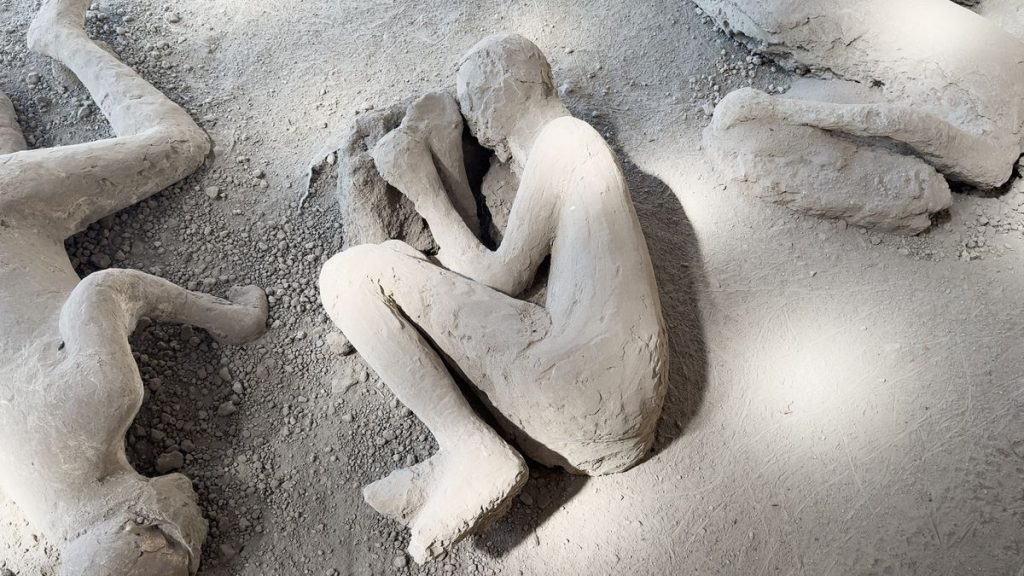
Archaeologists have made several extraordinary discoveries while carrying out a routine restoration on a cast located at Pompeii’s infamous Garden of the Fugitives

The man was discovered to be a doctor (Image: The Archaeological Park of Pompeii /Cover Images)
A doomed doctor may have spent his final moments trying to outrun the destruction of Pompeii in 79 CE, while desperately clutching his medical kit after the eruption of Mount Vesuvius.
Archaeologists investigating the infamous Garden of the Fugitives have uncovered evidence suggesting that one of the victims preserved in the volcanic ash was a medic, after identifying surgical tools, coins and medicine-making equipment in his vicinity.
Experts from the Pompeii Archaeological Park made the haunting discovery while carrying out restoration work on one of Pompeii’s most famous plaster casts, known only as Victim 46, whose body was found crumpled next to another victim in the final positions they died in as the Roman city was engulfed.
During the restoration, it was found that the cast concealed “a small personal assemblage” that had been concealed within the plaster for centuries. And what they found stunned researchers.
Buried within the victim’s remains was a small rectangular case containing medical instruments, including scalpel blades and a stone tablet used for grinding medicinal powders.
The report said: “The small rectangular case measured just 12.5cm by 5.2cm and was decorated with a thin bronze edge held together by tiny nails.”
“The surface of the object had grooved markings, suggesting it had been carefully crafted by hand.”
The box looked similar to Roman-era cosmetic and medical containers with sliding lids. Inside, archaeologists discovered a coticula – a small stone tablet with a dip in the middle that was used to grind and mix medicines or cosmetic powders.”
“The richness of the identified elements strongly supports the archaeological hypothesis that the subject was linked to medical practice,” the report concluded.
The doomed doc had also carried a cloth purse stuffed full of silver and bronze coins, perhaps hoping that money would be able to somehow buy him safety as panic spread through the city.
The Garden of the Fugitives remains one of Pompeii’s most horrifying locations, where the plaster casts of men, women and children still lie where they collapsed while attempting to flee. Researchers described the victims as “bodies caught in the act of flight” with “faces impressed in plaster like photographs of an eternal instant.”
High-tech CT scans later revealed one more eerie detail.
Medics at the Maria Rosaria Clinic discovered the box contained “a refined gear-and-knob mechanism” designed to tightly seal its contents. The scans also uncovered at least six hidden metal objects that are still trapped inside the cast.
For the latest breaking news and stories from across the globe from the Daily Star, sign up for our newsletters.