2 humpback whales swam record-breaking distance between breeding grounds, photos reveal
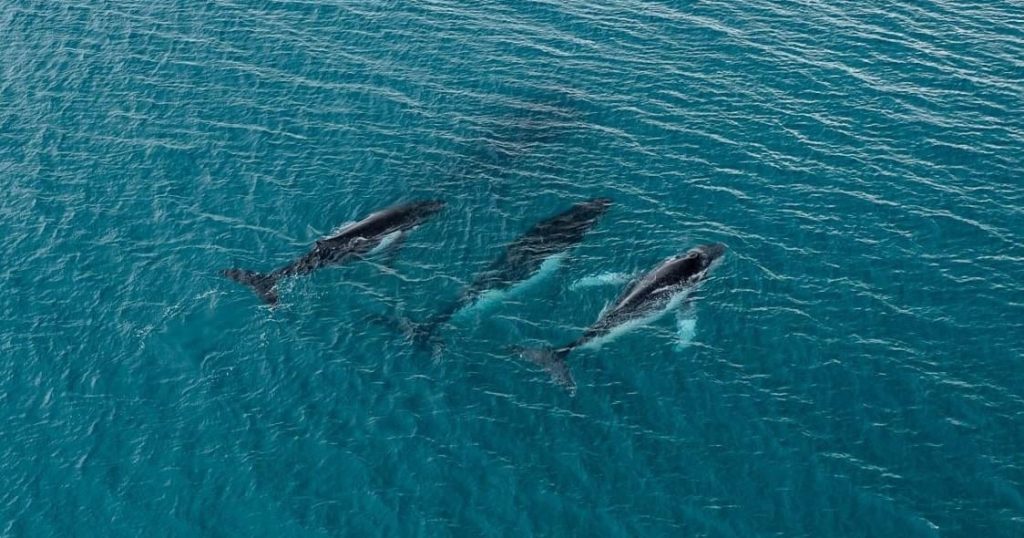
A pair of humpback whales swam between the eastern shores of Australia and breeding grounds in Brazil, research published on Wednesday found. The distances of the journeys are the greatest ever recorded.
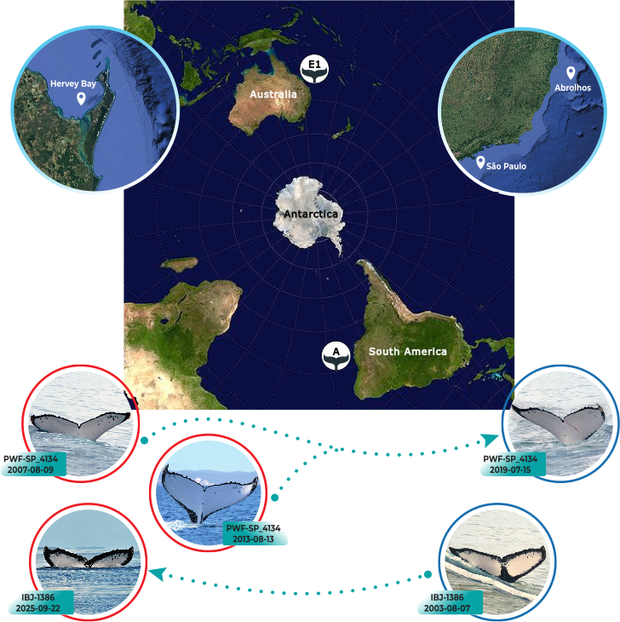
The work by a team of international scientists used tens of thousands of images taken of whale tales to identify the two vast sea-dwelling mammals and reveal they had popped up on both sides of the world.
One was spotted in Queensland in 2007 and then appeared near Sao Paulo, Brazil, in 2019 — a distance across oceans of about 8,823 miles.
Another was seen off the coast of Bahia in Brazil before being sighted 22 years later in Hervey Bay, Australia, about 9,383 miles away, according to the study published in Royal Society Open Science.
The pictures represent the longest distance ever seen between two pictures of the same humpback whale, researchers said.
Such vast journeys by the whales — which can grow up to 55 feet long — are exceedingly rare, they added.
“Despite their rarity, these exchanges matter for the long-term health of whale populations,” Griffith University PhD researcher and report co-author Stephanie Stack said.
“Occasional individuals moving between distant breeding grounds can help maintain genetic diversity across populations,” she added.
They “may even carry new song styles from one region to another — humpback whale songs are known to spread culturally across ocean basins, much like music trends in human populations.”
The study drew on nearly 20,000 photographs collected between 1984 and 2025 from eastern Australia and Latin America, contributed by both scientists and citizen scientists. The photos were run through an automated image-recognition algorithm, and the team was able to identify two humpback whales that had been photographed in both regions.
“This kind of research highlights the value of citizen science,” Dr. Cristina Castro of Pacific Whale Foundation said in a statement. “Every photo contributes to our understanding of whale biology and, in this case, helped uncover one of the most extreme movements ever recorded.”
Royal Society Open Science
Researchers said the work also leant further credence to a theory about humpback whale patterns known as the “Southern Ocean Exchange.”
That hypothesis suggests the mammals sometimes travel to feeding grounds in the Antarctic but then take a different journey home — ending up in a completely new breeding area.
“Climate-driven changes to the Southern Ocean, including shifts in sea ice and the distribution of Antarctic krill (the whale’s main prey), may be making such crossings more likely over time,” Griffith University said.
Due primarily to commercial whaling, humpback whales were listed as endangered in the U.S. in the 1970s, according to NOAA, and a final moratorium on commercial whaling was established in 1985. Currently, four out of the 14 distinct population segments are still protected as endangered, and one is listed as threatened, NOAA says.
2 humpback whales swam record-breaking distance between breeding grounds, photos reveal
#humpback #whales #swam #recordbreaking #distance #breeding #grounds #photos #reveal