NASA names 2027 Artemis III moon mission crew after Blue Origin rocket explosion
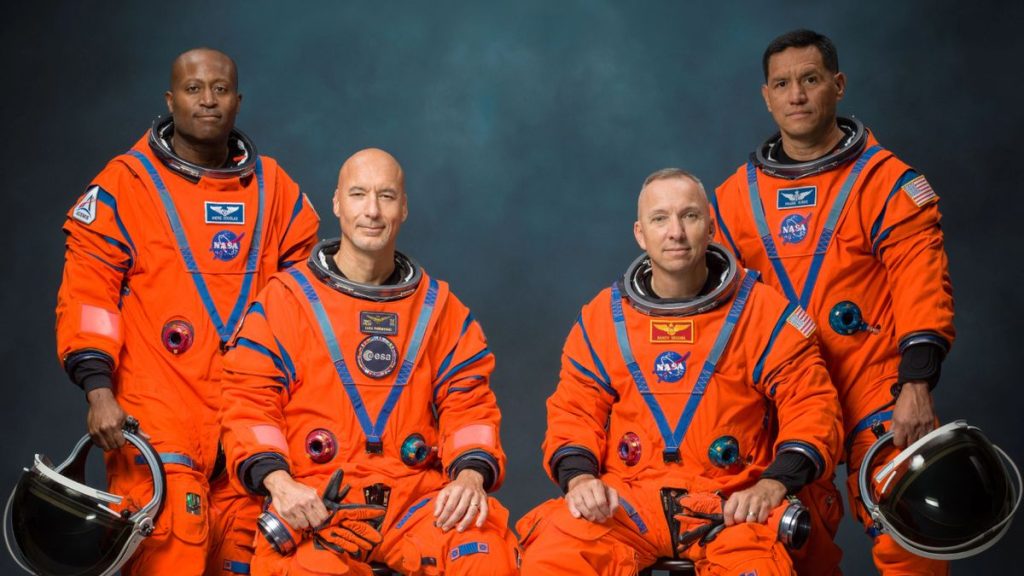
NASA has announced the four-person crew for its Artemis III lunar mission as the space agency presses ahead with its 2027 launch plans despite Blue Origin’s New Glenn rocket exploding last month

The Artemis III crew including, from left, Andre Douglas, Luca Parmitano, Randy Bresnik and Frank Rubio(Image: NASA via AP)
Nasa is forging ahead with the launch of its next mission crucial to returning humans to the Moon, despite a recent blow when a rocket from Jeff Bezos’s Blue Origin erupted in flames. The space firm established by the billionaire Amazon tycoon holds a vital position from the beginning in creating a base on the lunar surface.
Yet its primary transport system was the New Glenn rocket, which exploded during an engine test at the close of last month. Nevertheless, senior Nasa official Jeremy Parsons declared “setbacks are a learning opportunity” and Nasa was deploying all its knowledge “to help solve the problems that are here today“.
Blue Origin executive John Couluris also confirmed “excellent progress” has been achieved following the “significant anomaly” on May 28 and emphasised the company’s determination “to be part of the journey of returning humans to the Moon”.
He stated they would be judged not only by their achievements “but how we respond to setbacks”. The duo delivered their remarks as Nasa unveiled the astronauts who would participate in the Artemis III mission, slated for launch next year.
The four crew members will examine low Earth orbit docking procedures between the Orion spacecraft and commercial lunar landers, created by Blue Origin and Elon Musk’s SpaceX, that are set to transport humans to the surface of the natural satellite in 2028.
The astronauts were identified as Andre Douglas, Frank Rubio and Randy Bresnik from Nasa and Italian Luca Parmitano from the European Space Agency.
Their expedition forms part of ambitious plans to establish a lunar base that could witness people residing and operating on the moon’s surface within six years.
The groundbreaking initiative, which seeks to advance the technologies required for future deep space journeys, including to Mars, will be implemented across three phases.
However, the Artemis III mission and subsequent lunar development depends partly on the heavy-lift New Glenn rocket, named after John Glenn, the first American to orbit Earth.
Mr Parsons, who leads Artemis, said: “We have many partners involved in making Artemis III successful and while we recognise there are questions about how Blue Origin’s recent anomaly impacts our plans, setbacks are a learning opportunity.
“We are confident that New Glenn will be ready for Artemis III, together with Blue Origin, but Nasa is stepping in and bringing all of our expertise and capabilities to bear.
“We are working hand in hand with them to meet our commitments to return our nation to the Moon.
“Let me assure you, Nasa is taking an active role with all of our partners, contractors, and vendors to help solve the problems that are here today, and ensure the right outcomes are achieved.”
Mr Couluris, senior vice president of lunar permanence at Blue Origin, said: “As you know, we had a significant anomaly at our launch complex 36a on May 28.
“The response from Nasa, our partners and customers has been extraordinary. We’re making excellent progress on the investigation and pad clean-up.
“We’ll begin rebuilding once clean-up is complete, while continuing construction at launch complex 36b.”
He further stated: “Blue Origin is very motivated to be part of the journey of returning humans to the Moon. We’ve redoubled our efforts and are moving forward.”
Mr Couluris continued: “The Moon is the eighth continent, and we will measure ourselves not only by our successes, but how we respond to setbacks.”
SpaceX vice president Jessica Jensen expressed: “We’re incredibly excited to help return humans to the Moon once again, and this time to stay.”
Announcing the Artemis III team at the Johnson Space Centre in Houston, Texas, Nasa chief Jared Isaacman declared: “We are returning to the Moon.
“A grand adventure back to the lunar surface to build a moon base, and to do so for all of its scientific, its economic potential and to master the skills for where we will inevitably go next.”
He added: “The Nasa astronauts, alongside our international partners, and tens of thousands of the best and brightest across the agency and industry, are ushering in the golden age of discovery.
“They are carrying, carrying forward the hopes and dreams of the next generation, just as the Apollo astronauts did for so many of us.”