U.S.-Iran deal signing gets more ships moving in Strait of Hormuz, but big challenges remain
Increase in ships transiting Strait of Hormuz
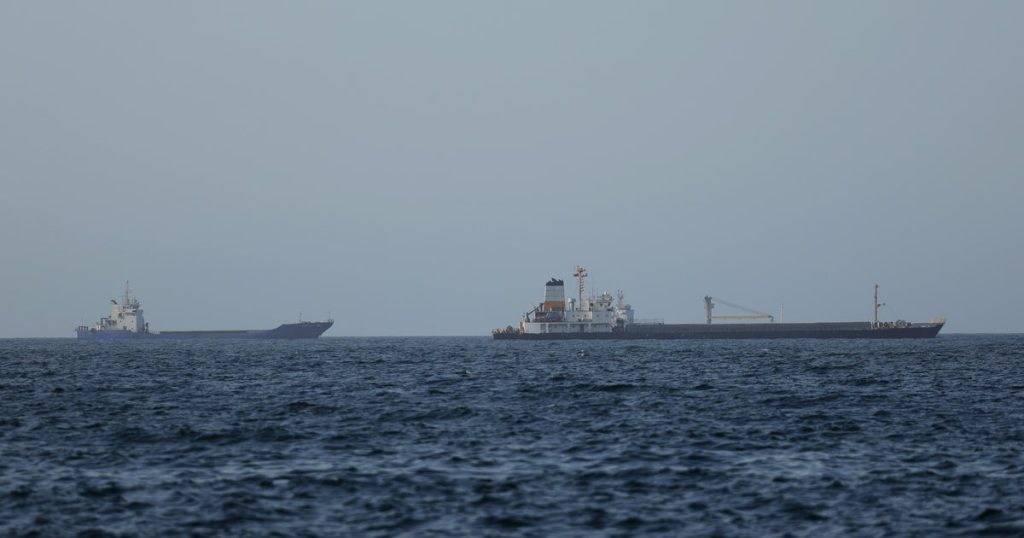
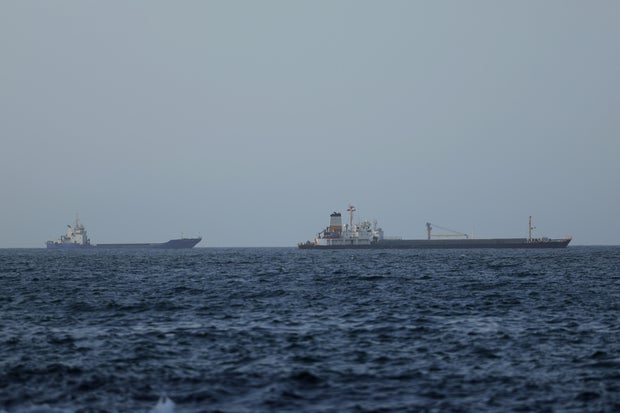
At least 10 commercial vessels were tracked transiting the Strait of Hormuz Thursday morning, and six more appear to be heading in the same direction to exit the Persian Gulf.
It’s a noticeable increase in traffic, but still far below the pre-war average of around 135 ships per day moving through the vital waterway, which is the only route in and out of the Gulf.
Among the ships is a French-flagged liquified natural gas (LNG) carrier, Mraikh, which is operated by QatarEnergy. A ship carrying vehicles owned by Italian logistics company Grimaldi Group was also making the crossing, months after dropping off its cargo at Persian Gulf ports. Both ships were among the hundreds stuck in the Persian Gulf since the start of the war, according to data from MarineTraffic.com.
Shady Alassar/Anadolu via Getty Images
Cargo ships and oil tankers owned by Hong Kong and Chinese companies were still broadcasting that they had Chinese crew on board, a tactic adopted by mariners at the start of the conflict when Iran said it would target ships linked to the U.S. and Israel.
Several sanctioned Iranian tankers that crossed the U.S. naval blockade line earlier in the week were still en route to Iranian ports Wednesday morning.
Israel reportedly in talks with U.S. over Lebanon troop withdrawal
Israel is holding negotiations with the U.S. as it seeks to keep troops deployed in southern Lebanon, according to two Israeli officials quoted by the Reuters news agency.
The deal struck between the U.S. and Iran calls for the “permanent termination of military operations on all fronts, including in Lebanon.”
While Israel is not explicitly named in the agreement, the continued presence of its troops in southern Lebanon is considered by Iran to be a violation of this clause.
A senior Israeli official told Reuters on Thursday that Israel was “conducting stubborn negotiations” with the U.S. over the deployment of its forces in southern Lebanon.
Prime Minister Benjamin Netanyahu’s office did not respond when contacted by CBS News for comment on the report.
Israel’s military says 1 soldier killed in Lebanon, 7 wounded
The Israeli military announced on Thursday that one of its soldiers had been killed in fighting in southern Lebanon the day before in an incident that also wounded seven soldiers.
Master Sgt. Alexander Filin, 29, “fell in combat,” the military said in a brief statement, adding that an officer, a reserve officer and a reserve soldier were moderately wounded.
A combat non-commissioned officer, two reserve soldiers and a female reserve soldier were lightly wounded, the military added.
The United States and Iran signed a memorandum of understanding on Wednesday meant to end the Middle East war, with fighting halted on all fronts, including in Lebanon.
Lebanon was drawn into the conflict when Tehran-backed Hezbollah fired rockets at Israel on March 2 in support of Iran.
Lebanon said earlier that Israel’s massive campaign of airstrikes and ground invasion has so far killed more than 3,800 people.
Israel’s side saw 31 soldiers and one civilian contractor killed since March 2.
Pakistan says deal will take “immediate effect,” with Iran opening Strait of Hormuz and U.S. dropping blockade
The U.S.-Iran memorandum of understanding will take “immediate effect” now that the presidents of both countries have signed it, said Pakistani Prime Minister Shebhaz Sharif, who helped mediate talks between the two sides.
Sharif also wrote on X that “as a first step, Islamic Republic of Iran will instantly reopen the Strait of Hormuz and the United States of America will immediately lift the naval blockade.”
“The signing of this agreement at the highest level of the respective governments demonstrates the commitment of both sides to a diplomatic resolution of the conflict,” he said.
President Trump and Iranian President Masoud Pezeshkian signed the memorandum of understanding on Wednesday, a U.S. official told CBS News. Mr. Trump later told reporters that he signed the deal in Versailles while taking part in a reception hosted by French President Emmanuel Macron after attending the G7 summit.
In Iran’s system of government, the most powerful official is not the president, but Supreme Leader Mojtaba Khamenei.
U.S.-Iran deal signing gets more ships moving in Strait of Hormuz, but big challenges remain
#USIran #deal #signing #ships #moving #Strait #Hormuz #big #challenges #remain