Google Genie 4 Builds Living Worlds With Sound Physics and Real Time Control
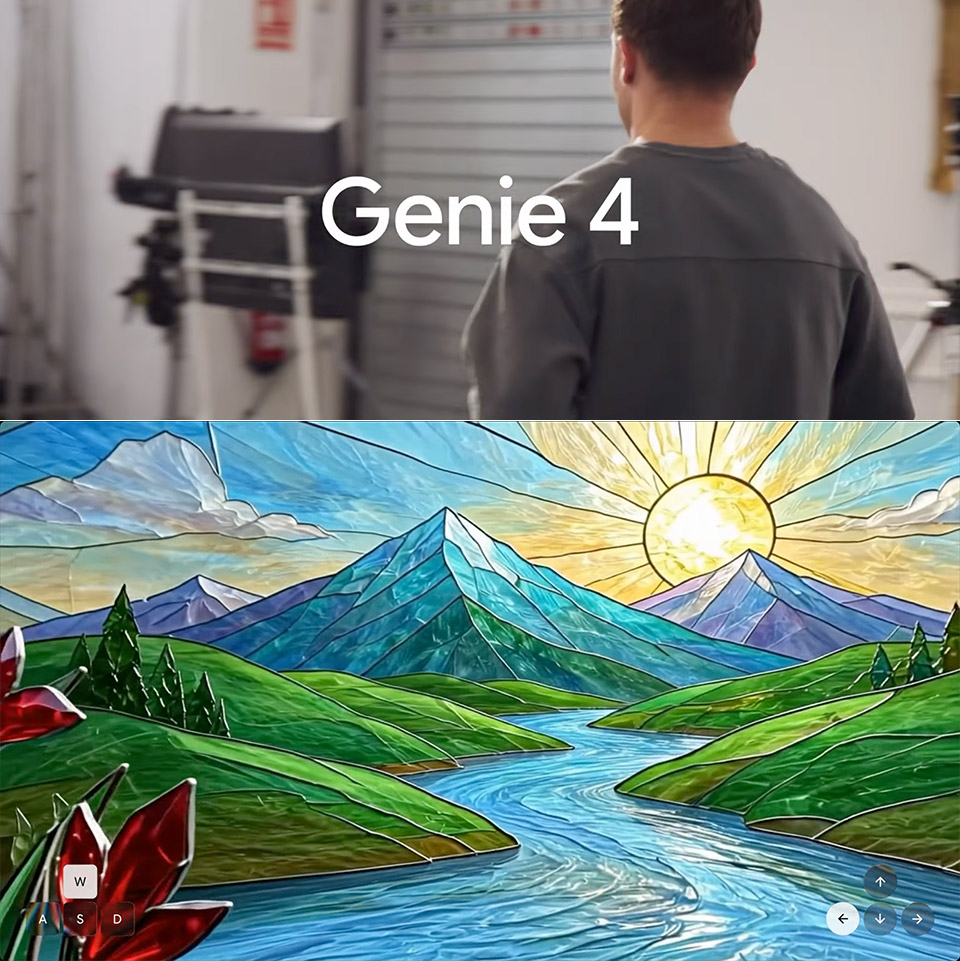
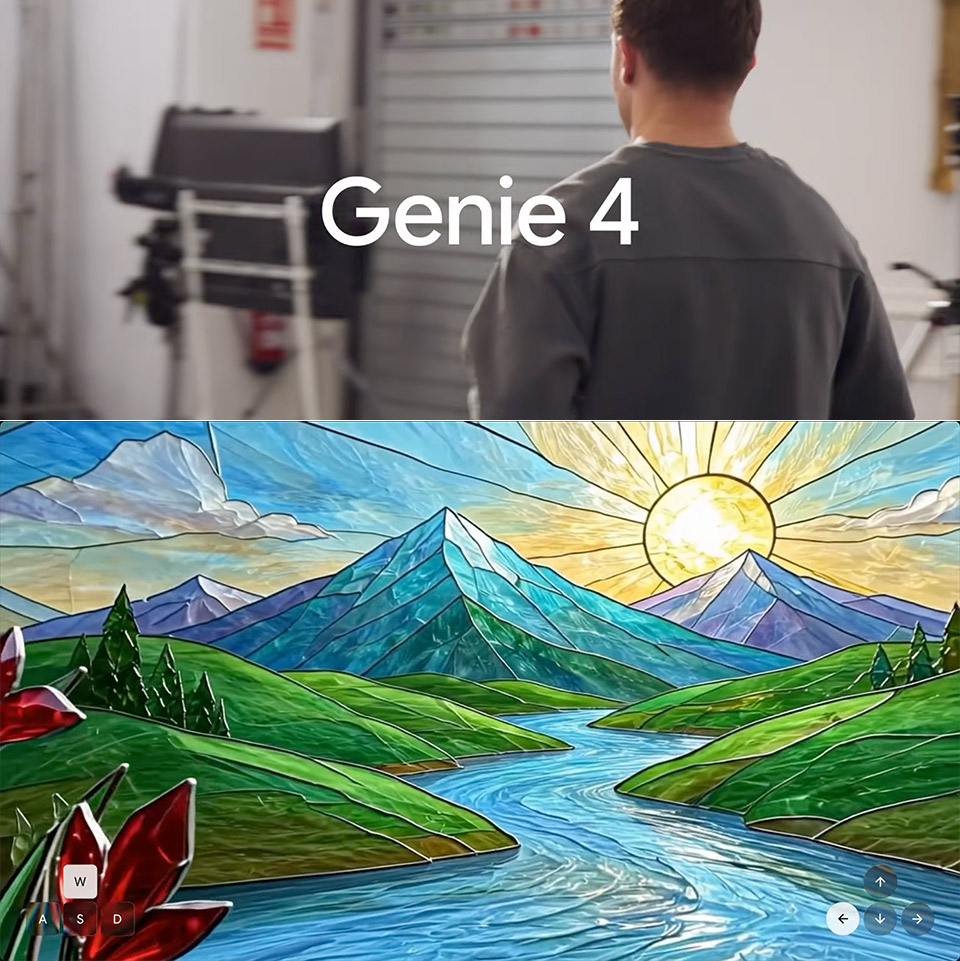
Google’s DeepMind just opened the next chapter in world models with Genie 4, a system that generates explorable environments on the fly and keeps them coherent while you move through them. You start with a text prompt or a reference image, and the model produces the scene pixel by pixel as you navigate. Standard keyboard controls let you walk or fly around while the world responds in the moment.
Physics gets the most love. Aerodynamics and collisions now act much more as they do in real life, so you can see a maple seed float and spin its way down to the grass, a watermelon smash against the sidewalk and spill its juicy insides everyplace, and fabric billow in the wind without looking rigid and unnatural. People move more naturally and with better timing. A saxophonist leans back and forth as he performs, a crowded 1980s train station feels realistic, and a dragon’s wings beat with actual force when you soar on them. Earlier iterations of this technology made humans appear like robots or trapped in place; with this improvement, figures respond to their surroundings and can be steered via mid-scene action.

Google Fitbit Edge – Activity Tracker – Black/Obsidian – Small & Large Band | Advanced fitness tracker…
- Meet the new Google Fitbit Edge, your daily health and fitness companion featuring personal coaching built with Gemini[1]i; get advanced health…
- A SEAMLESS FIT THAT’S READY FOR YOUR DAY: Sleek and designed for comfortable all-day wear, with a glanceable display for quick views of your stats…
- A NEW RELATIONSHIP WITH YOUR HEALTH: Google Fitbit Edge works with the Google Health app to help you stay motivated, and a Google Health Premium…
Audio is finally given the respect it deserves and is not treated as an afterthought. The whole environment is filled with ambient sound that corresponds to the situation, such as wind rustling through trees, waves breaking on a beach, or distant city noise. Music appears when it makes sense in the context. The main innovation here is that characters can have actual talks and short exchanges with one another, and when the situation or stimulus changes, so do their reactions. The whole system works in real time, so lip movements and background noise are in sync with what’s on screen.
Control works through ordinary language. You can ask for a weather change, a new camera angle, or the arrival of another person or object, and the scene incorporates the request without restarting. Gemini 3.8 Flash functions as a guiding layer, constantly monitoring the screens, breaking down large goals into manageable steps, and changing the strategy as the simulation progresses. Between your prompts, it monitors progress to ensure that everything remains coherent over the course of a short session. DeepMind collaborated with Gemini Omni to ensure that characters and objects react more realistically, and they’ve even experimented with integrating it with Gemini 4 Argon for robotics tasks such as breaking down procedures into simulated steps before attempting them on a physical robot.
Sessions hold together for about two minutes, roughly double the limit of the prior version, before visual details and object permanence begin to drift. That’s about enough time for a brief exploration or directed sequence, but this is still only a prototype; complicated scenes, long-term memory, and text that can be read are still a long way off. Every output bears a SynthID watermark, and for the time being, only a restricted number of trusted testers have access to it. However, it is scheduled to be made available to Google AI Ultra subscribers within Project Genie, as well as early partners via the Gemini API and AI Studio.
The practical uses under discussion include pre-visualization for film, quick tests of game ideas, and safe practice environments for robots and agents that need to practice navigation or multi-step tasks. Because the worlds are constructed on the fly rather than pre-built, each run may be slightly different. DeepMind sees this as one step toward creating systems that can reason about the physical world, and the first step is to train them to replicate it.
Google Genie 4 Builds Living Worlds With Sound Physics and Real Time Control
#Google #Genie #Builds #Living #Worlds #Sound #Physics #Real #Time #Control