U.S. launches new wave of strikes in escalating battle over Strait of Hormuz
Lebanon, Israel conclude two days of “positive” talks: U.S. official
Lebanon and Israel completed a new round of Washington-mediated negotiations in Rome on Wednesday, agreeing to implement the “pilot zones” in southern Lebanon agreed under a recent framework deal, a U.S. official said.
“Talks concluded after two days of productive and positive discussions,” the official said, adding the participants “agreed on the structure and guidelines for the pilot zone process, to be finalized and implemented in the coming days.”
The U.S.-brokered negotiations took place in the Italian capital over the framework agreement sealed last month after five rounds of talks in Washington, with Lebanese negotiators hoping for progress on an Israeli withdrawal from southern Lebanon.
The deal seeks an end to the war in Lebanon, disarmament of Hezbollah, the deployment of Lebanese troops in the south and for Israeli forces to steadily withdraw from the country, starting with two “pilot zones.”
Lebanon and Israel, who have no formal relations, started negotiations after Iran-backed Lebanese group Hezbollah drew its country to the broader Middle East war by attacking Israel in March.
Iran’s Araghchi visits Qatar days after Iranian attacks
Iran said Foreign Minister Abbas Araghchi traveled to Qatar on Wednesday to pay tribute to its deceased former emir, days after the Islamic republic launched salvos at the gas-rich emirate.
Araghchi is scheduled to “meet with Qatari authorities and offer his condolences,” the foreign ministry said in a statement, following the death on Sunday of Sheikh Hamad bin Khalifa Al Thani, who ruled the Gulf state from 1995 to 2013.
The visit comes amid renewed hostilities between Iran and the United States, which have surged to a scale unseen since an April ceasefire.
Qatar, which hosts the largest American base in the Middle East, said it was targeted by an Iranian attack on Sunday.
Trump to address defense technology gathering as Iran war has reduced U.S. weapon stocks
President Donald Trump is headlining a defense summit at the U.S. Army War College on Wednesday, planning to tout major investments in battlefield technology when the war in Iran has reduced the U.S. supply of Tomahawk cruise missiles and Patriot and THAAD interceptors.
The gathering in Carlisle, Pennsylvania, is organized by Republican Sen. David McCormick.
The White House said the summit is bringing together key leaders in defense and some of the largest global investors to spotlight the importance of national security and identify investment opportunities.
An analysis released in May found that U.S. military contractors will need at least three years to replenish stockpiles of Tomahawks, which are used to strike targets deep inside enemy territory, as well as Patriot and THAAD interceptors, which defend against incoming missiles and drones.
Stocks have dwindled as the U.S. has repeatedly fired strikes on Iran, adding to concerns that American forces would have limited firepower in any potential future conflict with China.
Mr. Trump has sought to correct the shortfall by seeking a historic $1.5 trillion defense budget proposal for 2027. But a package authorizing such spending levels is stalled in Congress, and, even if it eventually moves forward, loads of additional time will still be required to expand production capabilities to accommodate such weapons systems.
2 vessels intercepted by reinstated blockade on Strait of Hormuz, U.S. military says
The reinstated U.S. military blockade on the Strait of Hormuz has intercepted two vessels over the 17 hours it has been in place, according to U.S. Central Command.
President Trump announced he was putting the blockade back in place earlier this week.
“We are reinstating the THE IRANIAN BLOCKADE, so named because it is only stopping Iran’s ships or customers from entering or leaving,” the president posted Monday morning on Truth Social. “All other countries will have fair and open use of the Strait.”
The first blockade ran from April 13 to June 18 and intercepted more than 140 vessels coming into or out of Iranian ports.
Shipping intel firm notes “growing loss of confidence” in Strait of Hormuz route pushed by Trump
There’s a “growing loss of confidence” among shippers in using the southern route through the Strait of Hormuz, close to Oman’s coast, business intelligence firm Kpler said Wednesday. President Trump has repeatedly urged vessels to use the route despite Iran’s threat to fire on any ships that approach the passage.
Kpler said there was a slight increase in strait transits (21 in total) on Tuesday, but that all of the ships used the northern shipping lanes close to Iran, which Iranian officials had urged vessels to take in coordination with its military until Tehran declared the strait completely closed early this week.
But despite the small number of ships getting through, Kpler said, “the security outlook deteriorated further as three additional attacks off Oman were verified, bringing the reported toll to 56 confirmed incidents and 17 seafarer fatalities.”
“The absence of Omani route transits highlights a growing loss of confidence in that corridor, while shipping continues to favour Iranian approved routing,” it said, adding that while the strait remains passable, “the operating environment is becoming increasingly complex and unstable.”
Iranian state TV insists Strait of Hormuz “remains closed to all vessels,” says warning shots fired at 2 ships
Iran’s IRIB state TV network reiterated the regime’s insistence on Wednesday that the Strait of Hormuz remains closed to all vessels, and it said two commercial ships attempting to pass through the strait “illegally” — without coordination with Iran — were targeted with warning fire and stopped.
The report claimed all ships in the area were stationary at various anchorages in the strait, the Persian Gulf and the Gulf of Oman, with no movement toward the strait.
As he announced a resumption of the U.S. naval blockade of Iran’s ports and vessels on Tuesday, President Trump also reiterated his assertion that the strait “is open to ALL Ship traffic except for Iran.”
While the White House and Iran argue over whether the strait is open or closed, in practical terms, Iran’s ongoing attacks and threats have kept traffic through the vital waterway virtually gridlocked. Recent days have seen no vessels transiting the strait with their location transponders switched on, though some have made the passage previously without broadcasting their locations.
There was no immediate confirmation of new attacks targeting vessels in the strait on Wednesday, but Iran has struck at least four ships since Mr. Trump and his Iranian counterpart signed a memorandum of understanding aimed at reopening the waterway in mid-June.
The ceasefire agreed to as part of that MoU has broken down over the last week.
Video shows explosions at southern Iranian port as U.S. announces new attacks
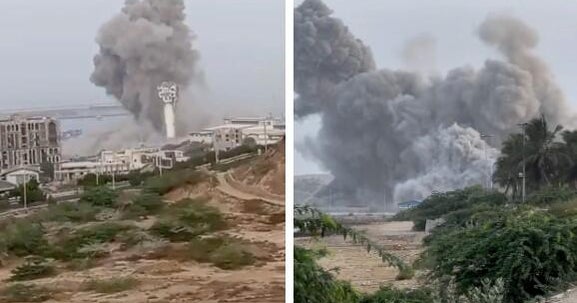
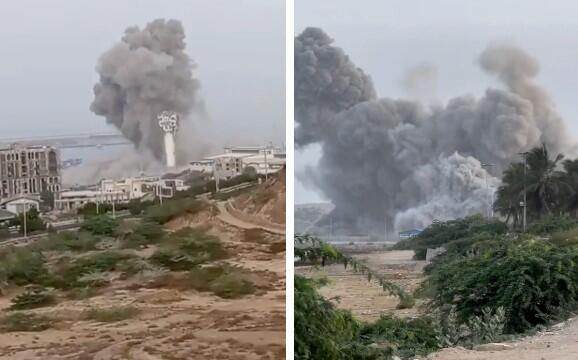
Video verified by CBS News shows a thick column of smoke rising from the Iranian port town of Chabahar on Wednesday.
Iranian state media reported American strikes on the city Wednesday, as U.S. Central Command announced a new wave of strikes.
Chabahar is home to a commercial port about 200 miles east of the Strait of Hormuz, in far southern Iran.
European aviation authority warns airlines not to fly over Persian Gulf region as war intensifies
The European Union Aviation Safety Agency warned airlines Tuesday not to fly through some Persian Gulf states’ airspace amid stepped up attacks by the U.S. on Iran, and Iran’s retaliatory fire at American allies and commercial vessels.
EASA issued an advisory that it said would remain in place at least until July 29 warning carriers to avoid the airspace of Bahrain, Kuwait, Qatar, the United Arab Emirates and parts of the Gulf of Oman.
It notes that implementation of the U.S.-Iran ceasefire agreed in mid-June – which President Trump declared “over” a week ago, “has been subject to recurrent and significant violations, creating again, a high level of risk across the Gulf region.”
“The heightened readiness and activation of national and U.S. air-defense systems increase the risk of misidentification, unintended engagement and collateral effects affecting civil aircraft,” the EASA notice says, adding that “unpredictable military developments, combined with the possible use of missiles, drones, combat aircraft and air-defense systems, create a high risk to civil flights at all altitudes.”
Price of oil remains over $85 a barrel as war intensifies
International benchmark Brent crude oil was still trading over $85 a barrel Wednesday as intensified strikes in and around the Strait of Hormuz continue hampering the flow of oil and gas through the vital shipping lanes.
Brent crude shot up to $86 a barrel Tuesday, a one-month high, after President Trump announced the U.S. would reimpose its naval blockade of Iran’s ports and associated vessels.
Brent was trading early Wednesday at $85.50, while U.S. benchmark Texas Intermediate was selling for just under $80, both still significantly higher than pre-war levels, but below the peak of almost $120 per barrel that Brent hit at the height of the conflict.
U.S. military announces new strikes on Iran
The U.S. military’s Central Command announced a new wave of strikes on Iran Wednesday morning, following a seven-hour barrage overnight.
“The strikes are designed to further degrade military capabilities Iranian forces have used to attack commercial shipping in the Strait of Hormuz,” CENTCOM said in a statement posted on social media.
The new strikes were announced just hours after the fourth consecutive nighttime assault, with the pace of attacks increasing since President Trump declared the ceasefire over on July 8.
Iranian officials report at least 30 killed, 260 injured in recent strikes
The latest round of overnight U.S. airstrikes on Iran injured more than 260 people, an Iranian health ministry official said Wednesday.
The comment by Hossein Kermanpour, a spokesperson for the ministry, did not include fatality statistics.
In a separate statement, an Iranian government spokesperson claimed at least 30 people were killed in “recent days,” without specifying exact dates.
Jordan, Bahrain and Kuwait report incoming attacks from Iran
The Kuwaiti military said early Wednesday morning local time it is confronting “hostile drone attacks” from Iran, hours after announcing it had shot down dozens of drones and missiles and reporting an Iranian strike on a Kuwaiti warship.
Bahrain also said its alert sirens were sounding.
Meanwhile, Jordan’s army said Wednesday it had shot down three missiles from Iran, as Tehran pressed attacks on U.S. allies in response to American strikes.
U.S. reimposes blockade on Iran, carries out more strikes
The U.S. military reimposed a naval blockade on Iran and intensified its airstrike campaign early Wednesday.
U.S. Central Command (CENTCOM) said Wednesday morning it had completed a seven-hour wave of attacks across Iran “to further degrade Iran’s ability to threaten commercial shipping and civilian crews.”
Days of retaliatory strikes across the Middle East by Iran and the U.S., and both nations’ attempts to assert control over the Strait of Hormuz, threaten to push the region back to all-out war.
U.S. wraps up 4th consecutive night of strikes, CENTCOM says
U.S. Central Command said it struck dozens of Iranian targets over the course of seven hours Tuesday evening, including missile and drone sites and “coastal defense systems.”
The goal was to “further degrade Iran’s ability to threaten commercial shipping and civilian crews,” CENTCOM said in a post on X after the strikes were completed.
CENTCOM has struck Iran for four consecutive nights.
Trump says U.S. will hit Iranian power plants, bridges next week unless Iranians “get to the table and negotiate”
President Trump told Fox News the U.S.’s strikes against Iran could get “really bad” next week, with attacks on Iranian bridges and power plants.
“We’re going to hit them very hard tonight. We’re going to hit them very hard tomorrow night. We’re going to hit them very hard the night after,” he said. “And then next week, it gets really bad for them, because next week comes the power plants, next week comes the bridges.”
The president continued: “We’re going to knock out all their power plants, we’re going to knock out all their bridges. Unless they get to the table and negotiate.”
Mr. Trump has threatened to hit Iranian bridges and power plants in the past. Experts say attacks on civilian infrastructure can constitute a war crime, though the Trump administration has said it will hit legitimate targets used by the military.
The president also told Fox News’ Trey Yingst his representatives delivered a message to Iran earlier Tuesday, urging them to “make a deal.”
“We’re being very careful with the civilian population, as you know. But I said, ‘You better make a deal, you’re not going to have anything left,'” he said.
U.S. launches new wave of strikes in escalating battle over Strait of Hormuz
#launches #wave #strikes #escalating #battle #Strait #Hormuz